
Yes. A full roof replacement requires a building permit in every city and county we checked across Los Angeles and Orange County. There is no exception for residential, no exception for a simple tear-off, and no dollar threshold that lets you skip it.
The only genuine grey area is a small patch repair, and even there the rules differ by jurisdiction and several do not publish a safe number. If a roofer tells you your job is "too small to need a permit," ask them to put that in writing. Most will not.
- Permit required for a full reroof in all seven jurisdictions we checked: unincorporated LA County, City of LA, unincorporated Orange County, Anaheim, Santa Ana, Irvine and Huntington Beach.
- The 2025 California Building Code took effect January 1, 2026. City handouts still citing older code cycles are useful for local workflow but do not override current state code.
- You cannot put a third layer on. State code bars a recover where the roof already carries two or more applications of any roof covering.
- Wood shake and wood shingle are banned outright in the City of Los Angeles, including fire-retardant-treated, and have been since 1989.
- Unincorporated Orange County charges double the permit fee for work done without a required permit. That is before anything a buyer's inspector finds later.
- Every active C-39 roofing contractor must carry workers' compensation even with zero employees. There is no "no employees" box that gets a roofer out of it.
Do you need a permit?
Short version: assume yes, and treat any roofer who says otherwise as a warning sign rather than a bargain.
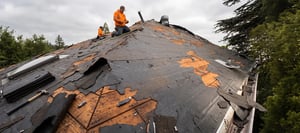
A full roof replacement means removing the covering down to the deck and installing a new system. That is structural work on the part of your house that keeps water out of it. Every jurisdiction we looked at treats it as permit work.
| Jurisdiction | Full reroof | Worth knowing |
|---|---|---|
| Unincorporated LA County | Permit required | Applications go through EPIC-LA. Use the county service locator first, because a Los Angeles mailing address does not mean you are in the City. |
| City of Los Angeles | Permit required | LAMC section 91.106 covers altering or repairing a structure and lists no roofing exemption. Straightforward reroofs may qualify for an Express Permit without plan review. |
| Unincorporated Orange County | Permit required | There is a specific Re-Roof Permit type, tied to a roof sheathing and framing inspection. |
| Anaheim | Permit required | Separate fee paths for lightweight versus tile, because tile usually needs structural calculations. |
| Santa Ana | Permit required | Its reroof handout is the only one we found publishing a repair exemption, but it is dated. See the next section. |
| Irvine | Permit required | Online reroof permitting, and the city independently requires an approved Class A rating on residential reroof material. |
| Huntington Beach | Permit required | Sheathing and final inspections both expressly identified. |
One thing that trips people up before anything else: find out which jurisdiction you are actually in. A mailing address that says Los Angeles, Whittier or Anaheim does not tell you whether the property sits inside city limits or in unincorporated county territory. They are different agencies with different fees, different forms and different inspectors. LA County publishes a service locator specifically because this confuses people constantly.
The code changed this year
The 2025 California Building Standards Code took effect January 1, 2026. Permit applications filed on or after that date fall under the 2025 Building Code, Residential Code and Energy Code, as locally amended. Projects that had a complete application in before the changeover generally stay on the 2022 code. This matters because several cities still publish reroof handouts written for the 2013 or 2022 cycle. Those handouts remain useful for local workflow, but where they conflict with current state code, the code wins.
What about small repairs?
This is the only honest grey area, and it is where most bad advice lives.
There is no uniform Southern California rule that repairs under some square footage are exempt. You will see "under 100 square feet" quoted confidently on roofing websites. That number comes from a Santa Ana reroof handout, and that handout dates to 2014 and cites the 2013 California Building Code. It may still reflect Santa Ana's practice. It is not a regional rule, and it should be confirmed with Santa Ana Building Safety before anyone relies on it in 2026.
The 100 square foot rule does not apply in the City of Los Angeles
We found articles telling Los Angeles homeowners that repairs under 100 square feet within a 12-month period are permit-exempt. LAMC section 91.106 prohibits erecting, constructing, altering or repairing a structure without a permit, and the enumerated exemptions do not include a roofing exception. If you are in the City, treat even localized roofing repair as permit-required unless LADBS tells you otherwise. Do not budget or schedule around a number you read on a contractor's blog.
For unincorporated LA County and unincorporated Orange County, neither publishes a clean roofing square-foot exemption we could point you to. That does not mean every patch needs a permit. It means the safe answer is a phone call, not an assumption.
Where the line is clearly crossed, in every jurisdiction: replacing or recovering a meaningful area of roof, replacing sheathing, altering framing, or installing a new roofing system. Those are permit work everywhere.
Pro tip from our crews
If you genuinely have a small repair and you want to know whether it needs a permit, call the building department yourself and get the answer with a name and a date attached. Write down who you spoke to. It takes ten minutes and it is worth infinitely more than a roofer's verbal assurance, because the roofer will not be the one explaining it to a buyer's inspector in four years. We do this for our own customers on borderline jobs and we put the answer in the file.
The two-layer rule
Here is the code rule that decides whether your job is a tear-off or an overlay, and it is not up to your contractor's preference.
Under the California Residential Code section R908 and Building Code section 1511, a roof recover is not permitted where any of these apply:
- The existing roof already carries two or more applications of any type of roof covering
- The existing roof or covering is water soaked, or has deteriorated to the point that it is not an adequate base for additional roofing
- The existing covering is slate, clay, cement or asbestos-cement tile
So the common shorthand, "I only have one layer so I can always add another," is only half true. Layer count is one test. Deck condition is another, and a roofer cannot assess it honestly without opening the roof up.
The City of Los Angeles goes further. It publishes a material-by-material compatibility table governing which new roof systems may go over which existing systems. Asphalt over certain existing asphalt and built-up systems is allowed, several metal combinations are permitted, and existing tile is generally not treated as a substrate for a conventional overlay. In the City, both the layer count and the material pairing matter.
Wood shake is banned in the City of Los Angeles
Not restricted. Banned. Los Angeles Building Code section 1505.1 states that no wood shake or wood shingle roof covering is permitted anywhere in the City, and current LADBS correction lists confirm that includes fire-retardant-treated wood. This traces back to City Ordinance 165,047, which took effect in August 1989 after the wood-roof fires of that era. If you own a home with an original wood shake roof inside City limits, you cannot replace it in kind. Plan for a different material.
Separately, where more than 50 percent of the total roof area is replaced within any one-year period, the City requires the entire roof covering to be at least Class A fire-retardant.
Fire zone rules sit on top of all of this. If your property is in a Very High Fire Hazard Severity Zone, additional assembly and material requirements apply, and they are not optional. Your building department confirms your zone. Do not take a zone designation from a sales presentation.
What a permit costs
Permit requirements are consistent. Permit fees are not. Two jurisdictions publish clear current reroof numbers, and the rest use valuation-based calculators that depend on your specific project.
- Unincorporated Orange County. The FY 2026 to 2027 schedule lists a residential reroof at $370, plus the countywide $45 permit issuance charge, for a $415 base before state or other applicable charges. Reroofing a detached garage alongside the main roof is listed at an additional $335.
- Anaheim. A lightweight reroof with no structural review, up to 3,000 square feet, is $364. A tile reroof requiring structural calculations, up to 2,000 square feet, is $503. Anaheim has published increases to $375 and $519 taking effect August 24, 2026.
- Everywhere else. Valuation-based or project-specific. Nobody can responsibly quote you a number without the address and the project value.
In the context of a re-roof, none of these figures should change your decision. A $415 permit on a $18,000 roof is roughly two percent, and it buys you an independent inspection of the most expensive assembly on your house. Anyone framing the permit as the reason to cut a corner is telling you something about how they work.
Energy code adds a document, not usually a big cost. Replacing 50 percent or more of the roof area is a key alteration trigger under the current Energy Code, and whether a cool-roof product is actually required depends on your climate zone, roof slope, insulation and attic configuration, plus specified exceptions. The compliance form has a dedicated roof replacement section asking for pitch, CRRC product identification, solar reflectance, thermal emittance and the applicable exception. Confirm the requirement for your specific address with the building department before anyone orders material.
The inspection that matters
Most reroofs get two inspections, and the first one is the one people accidentally skip.
- Permit issued before tear-off. Not during. Not after.
- Roof deck, sheathing or framing inspection, before the deck is covered. Anaheim, Santa Ana, unincorporated Orange County and Huntington Beach all expressly identify this one. Once underlayment and shingles go down, the inspector cannot see what is underneath.
- Final inspection after completion, expressly identified by Anaheim, Santa Ana and Huntington Beach among others.
- Keep the signed-off paperwork. Permit, inspection approvals, final sign-off, Energy Code documentation, product and warranty information, and disposal or recycling records.
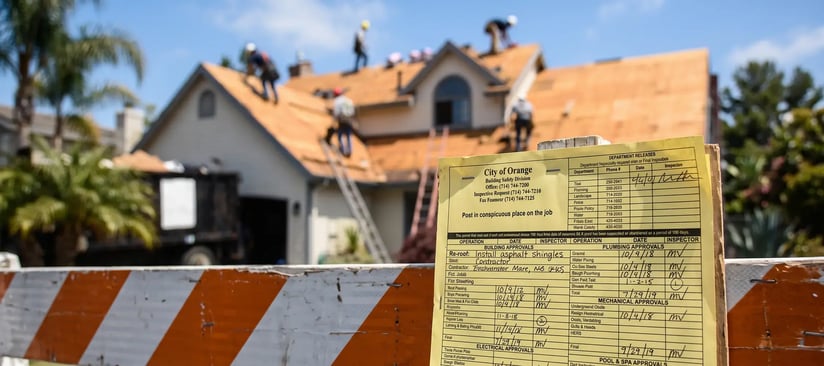
The sheathing inspection is the largest practical risk in an otherwise simple job. If a crew tears off and covers the deck the same day without calling for it, the inspection cannot happen, and getting the final signed off can become a real problem. LA County allows qualifying roof and sheathing inspections through its Remote Virtual Inspection program, which helps with scheduling, but the inspection still has to occur before concealment.
It is also the inspection that protects you. An exposed deck is the only moment anyone can see rot, soft plywood or previous water damage. That is the point where a change order is honest information rather than a surprise.
Check your roofer first
The permit rules and the licensing rules are separate, and the licensing side is where homeowners get hurt.
A permit means a license is required. Anyone contracting for work that requires a building permit must hold a current CSLB license, regardless of the dollar amount. The small-job exemption people cite applies only where the job does not require a permit, no employees are used, and the value is under the statutory limit. Since a normal reroof requires a permit everywhere in LA and Orange County, that exemption is not available for it.
C-39 is the roofing classification. A B General Building license is not an automatic substitute on a roof-only job. A B contractor generally needs to hold the specialty classification or subcontract the roofing to a C-39, unless the overall project involves at least two unrelated trades as the statute describes. Anaheim's own reroof bulletin reflects this by allowing a B contractor to pull the reroof permit where the signed contract includes the reroof plus two additional unrelated trades.
The workers' comp box that does not apply to roofers
Under Business and Professions Code section 7125, every active C-39 roofing contractor must carry workers' compensation insurance or a valid certification of self-insurance whether or not they have employees. CSLB will not accept the no-employee exemption from a C-39 licensee at all. Local permit applications often carry a generic "Exempt, No Employees" checkbox for all trades. A roofer ticking that box is not complying with the roofing-specific state rule. You will find websites saying a sole-proprietor roofer can file the exemption. CSLB's own page says they cannot.
- Look the license up yourself at cslb.ca.gov. Check the entity name on the contract, not the salesperson's name, and confirm the C-39 classification is active.
- Confirm workers' compensation is on file, which shows on the CSLB record.
- Confirm the $25,000 license bond is active. If it lapses, the license is suspended.
- Ask for a general liability certificate. California does not make one a universal condition of every license, so ask for it rather than assuming.
- Check the down payment. On a home improvement contract it may not exceed $1,000 or 10 percent of the price, whichever is less. On a $20,000 roof that is $1,000, not $2,000.
- Put the permit in the contract. State who pulls it, who pays for it, and who pays for engineering and disposal.
On owner-builder permits. You can legally pull a permit as an owner-builder, and sometimes it makes sense. But the exemption belongs to you, not to the roofer. Pulling the permit in your name does not make an unlicensed roofer legal, and it moves responsibility for supervision, safety and potentially payroll and workers' compensation onto you. If a contractor asks you to pull the permit as owner-builder so they do not have to, that request is the answer to a question you should be asking about them.
Skipping the permit
It usually seems harmless right up until it is not.
- An independent inspection of the deck before it is covered
- A record that the work met the code in force at the time
- Clean paperwork for a future sale, appraisal or insurance question
- A contractor whose license, bond and workers' comp were verified
- A final sign-off you can hand to a buyer
- Double permit fees. Unincorporated Orange County charges twice the fee for work done without a required permit
- An order to expose completed work so it can be inspected
- A sale that stalls when unpermitted work shows up in disclosure or an appraisal
- An insurance conversation you do not want after a loss
- No workers' comp coverage if someone is injured on your roof
That last one deserves saying plainly. Roofing is one of the more dangerous trades in construction. If an uninsured worker is hurt on your property and there is no workers' compensation policy behind them, the exposure can land on the homeowner. That is the real reason the C-39 workers' comp rule exists, and the real reason to verify it rather than take someone's word.
If you want the underlying decision framework before you get to permits at all, our guide on roof repair versus roof replacement covers when a repair is genuinely the honest answer, and 3-tab versus architectural shingles covers material choice. We are a roofing contractor in Los Angeles and Orange County, CSLB #1085596, and we pull the permit as part of the job.
Frequently asked questions
Who pulls the permit, me or the roofer?
Normally the contractor, and that is what you want. A licensed contractor pulling the permit in their own name puts their license behind the work. If a roofer asks you to pull it as an owner-builder so they do not have to, treat that as a red flag. It often means a licensing or workers' compensation problem on their end, and it shifts responsibility for the job onto you. Either way, put it in the contract: who pulls it, who pays for it, and who pays for engineering or disposal charges.
How much does a roof permit cost in LA or Orange County?
Unincorporated Orange County publishes a residential reroof at $370 plus a $45 issuance charge, so $415 before other applicable charges. Anaheim lists $364 for a lightweight reroof without structural review up to 3,000 square feet, and $503 for a tile reroof with structural calculations up to 2,000 square feet, with increases to $375 and $519 published for August 24, 2026. Most other jurisdictions use valuation-based calculators, so the number depends on your address and project value.
Can I just put a new layer over the old roof?
Only sometimes. State code bars a roof recover where the existing roof already has two or more applications of any roof covering, where the existing roof is water soaked or too deteriorated to serve as a base, or where the existing covering is slate, clay, cement or asbestos-cement tile. The City of Los Angeles adds a material compatibility table on top of that, so both the layer count and the pairing matter there. One existing layer does not automatically mean an overlay is allowed.
My roof is wood shake. Can I replace it with wood shake?
Not in the City of Los Angeles. Los Angeles Building Code section 1505.1 states that no wood shake or wood shingle roof covering is permitted anywhere in the City, and current LADBS guidance confirms that includes fire-retardant-treated wood. The ban dates to City Ordinance 165,047 in 1989. Elsewhere in LA and Orange County the answer depends on your jurisdiction and fire hazard zone, but wood is heavily restricted across the region and many insurers will not write a policy on it at all.
What if my roofer already did the work without a permit?
Contact the building department and ask about the correction process. Expect a penalty: unincorporated Orange County's fee schedule allows double the permit fee for work performed without a required permit. You may also be required to expose completed work so it can be inspected, which on a roof can mean removing new material. It is unpleasant, but it is far better handled now than discovered during escrow.
Does a small repair need a permit?
It depends on where you are, and there is no regional square-foot rule. A Santa Ana handout mentions repairs under 100 square feet, but it dates to 2014 and cites the 2013 code, so confirm it before relying on it. The City of Los Angeles prohibits altering or repairing a structure without a permit and publishes no roofing exemption. Unincorporated LA County and unincorporated Orange County do not publish a clean roofing threshold either. Call the building department and get the answer with a name and date attached.
Do I need a cool roof?
Possibly. Replacing 50 percent or more of the roof area is a key trigger under the current Energy Code, but whether a cool-rated product is actually required depends on your climate zone, roof slope, insulation and attic configuration, and there are specified exceptions. Los Angeles County spans more than one climate zone, so a blanket answer for the region is not possible. Confirm the requirement for your specific address with the building department before anyone orders material.
How do I check that a roofer is properly licensed?
Go to cslb.ca.gov and look up the license number on the contract, not the salesperson's name. Confirm the license is active, that it carries the C-39 roofing classification, that the $25,000 bond is in place, and that workers' compensation is on file. Every active C-39 must carry workers' compensation whether or not they have employees, so a roofer claiming a no-employee exemption is not complying. Also ask for a general liability certificate, which California does not require of every license type.
Alex Weis is a licensed roofing and general contractor (CSLB #1085596) with Hybrid Renovations, a residential contractor serving Los Angeles and Orange County for 7+ years. Every guide is written from real jobs and real local numbers.
A note on how to use this: permit rules, fee schedules and code cycles change, and they differ by address. This guide is general information for California homeowners, not a jurisdiction-specific determination. The building department with authority over your property is the only source that can tell you what your project actually requires. Hybrid Renovations is a licensed roofing and general contractor, CSLB #1085596, and we pull permits as part of every reroof we do.